Author: Simon

  • The Mystery Cut

    “Do whatever you think is best.”

    I hear that request often enough that it’s become a bit of an amber flag. Because what follows, almost always, is a “but.” “But don’t touch my ears.” “But I’ve got this cowlick.” “But I don’t want it asymmetrical.” The amber flag turns bright red.

    I don’t blame people for it. It’s the natural instinct when you’re in the chair. You want to trust the professional, you want to hand over the reins, but you also want to protect the things you’re worried about. So you offer me permission and then immediately take it back.

    But what if someone actually meant it?

    What if there was a service where you came in, sat down, and I got to decide. Not negotiate. Not compromise. Decide. Where the destination is mine to choose, and the timeline is mine to set. You might arrive with shoulder-length curls and leave with a pixie cut or you might leave with nothing done at all, if I think the real work is six years of growth. That would be £300 either way.

    I’ve been hesitant about offering this. It’s uncharted territory for me, and the load it puts on my shoulders is genuinely high. But I’m keen to explore it, because I think there are people who actually want this. Not the fantasy version of “do whatever you think is best” with all the caveats attached. The real thing.

    The reason people ask for it is usually simple: they want to know what a professional thinks. They want to hand over the thinking entirely and just trust. I get that. What I wasn’t sure about until recently is whether I could fully confidently step into that mode.

    But since I’ve been vardering with Paul, something’s shifted in how I approach a cut. My technique is developing new aspects to it. There’s a moment I’m not sure how to describe it where I can almost step into autopilot. Not in a mindless way. The opposite, actually. As if in a lucid dream. It’s like the decisions stop being conscious choices and I just… snip merrily away. The thinking gets out of the way and the work happens.

    I know there are people who need that from the other side of the chair too. They want to plonk themselves down and not have to think about anything. Not their appearance, not their choices, not the logistics of their own hair. They just want to exist in the chair and have someone else be responsible for the outcome.

    And now I want to offer that as part of my practice.

    Here’s what it would look like: You book in. We talk about your life, what you’re into, what you’re not into, your work, where you’re coming from, where you’re headed. I ask questions to understand these wider parameters. But you don’t get to decide the cut. You don’t get to show me pictures or describe what you want. That’s not the service.

    What you get is my professional eye, my experience, my belief in what would work for you. You get the cut I think you should have — whether that’s a radical change, a subtle refinement, or me telling you to grow it out for a year and come back. That’s the service. That’s the £300.

    The barrier for most people isn’t the money. It’s faith. It’s trust. It’s the vulnerability of saying “I don’t know what’s best for me, you decide.” Most of us are drowning in choice. We’re overwhelmed by options, by the need to have an opinion about everything, including our own hair. This service is permission to stop deciding.

    But it’s also a lot to ask of a hairdresser.

    Because if it goes ‘wrong’, and you hate it, there’s no “but I wanted shorter” to fall back on.

    You trusted me, and I made the choice. So the responsibility is mine, completely.

    That’s why I’m hesitant. That’s also why I want to do it.

    The other thing it requires is a different kind of relationship. You can’t come in once and never return. If I’m telling you to grow your hair out for six years, I need to see you periodically. I need to maintain the work. I need to be invested in the long game. It’s not a transaction. It’s a collaboration, except you’re trusting me to lead it entirely.

    I don’t even know fully how I’d execute this yet. But I’m starting to feel like I could. And I think there’s an honesty in offering it, even if it’s new territory. Even if it scares me a bit.

    So if you’ve ever wanted to say “do whatever you think is best” and actually mean it, then this is the service for you.

    This isn’t an impulse buy. Take your time. When you’re ready, you’re ready.

    If you’ve read this far, you’re probably there. When you are, and you’ll know, book here:
  • Swiss Church

    Local outreach

  • The Dream and the Horizon

    It’s an odd thing to achieve a lifelong dream and find, almost immediately, another one waiting on the horizon. You’d think the satisfaction of achievement would be more long-lasting. That you’d arrive, exhale, feel the horizon stop moving and the dream finally settle into place. But that’s not how it works, not for me at least.

    When I was younger I used to drop off Eugene’s prints at Windle so he could put them into his book. I’d collect them in from the photo labs on my bike, cycle them to wherever Eugene needed them, the salon or the agency, hand them over to reception, and leave. I’d stand in the salon for those brief moments and feel the atmosphere, a buzz. I knew then, that if I ever was going to work in a salon Windle was the place.

    It took me decades to get there. There was a career break in the middle, I took a decade to focus on what I’ve always known to be my true vocation: bringing up my children. Life took the shape it needed to take. The dream sat where dreams sit when you can’t act on them. Not gone. Just waiting.

    Then, in the spring of 2024, I put together a list of salons I’d like to work in. Of course Windle was the first place to go on that list. I interviewed at a few, quite an eye opener, and miraculously, within a month I found myself stepping through the door at Windle.

    I felt like Aladdin stepping into a cave full of treasure. It’s not a return to a previous chapter, it’s literally a dream come true. Finally stepping inside a building I’d go out of my way just to walk past, so I could fantasise about working there. Inside it’s obviously a bit different, bigger now, but the atmosphere I’d sensed in reception all those years ago — the focused calm — is still there.

    So that’s another dream achieved. I expected this might finally settle something, but of course it didn’t.

    Because almost as soon as I’d landed inside the salon where I’d wanted to be for so long, the session work horizon reappeared. I knew Eugene still prepped there sometimes — Paul mentioned this at my interview.

    Then one day Paul and I were chatting in reception and in walks guess who: Eugene. And when he sees me, he says “Simon!”

    Knees go to jelly. Starstruck, despite my best efforts to conceal it — because I know that irks Eugene’s humility. I think he’s never been comfortable with the intensity of admiration that follows him around, and so I tried to dim it on his behalf. But 30 years on he’s still at the top of his game — just like KRS — and I couldn’t conceal that. Even just offering him a cup of tea I felt like a sycophant.

    The next thing I know, we’re walking through the salon to the garden at the back, catching up on lost time and in passing he casually says: We’ve got to get you back on the team.

    I’d said to Paul that I was afraid this might happen. In fact I think the exact phrase I used was that “I was scared I’d be tempted to run away to the circus,” in what I thought was the highly unlikely scenario whereby Eugene would a) recognise me and b) invite me back to the world of shows and shoots and call sheets. The world I loved all those years ago.

    So of course I declined the offer…

    Oh how it pains me to see that written down!

    But I mustn’t be too hard on myself. I declined because I wanted to focus my attention on my chair in the salon. But that wasn’t the only reason. I’m in a phase of life where work could easily become a way to avoid other things. Where the circus could be less about the work itself and more about not having to be present for everything else. I didn’t want to fall into that addictive mode. And I was still shedding the last vestiges of impostor syndrome at that point. I know how easy it is not to maintain a healthy work-life balance. Living in London I see it all around me. That’s part of why I held back, even though deep down I could feel every cell in me wanting to say yes.

    And there was something else underneath all of that, which I’ll come to.

    I was also, frankly, chasing the wrong thing. There’s a KRS-One clip I think about a lot:

    [KRS-One video embed placeholder — the principle: chase the money and it runs away, do it for the culture and the money chases you.]

    As far as I can see, this is exactly Eugene’s MO. And that’s exactly what I’d lose sight of if I jumped at the offer too early, before I had stabilised my foundations at the salon. Before I’d grounded myself.

    So I wrote him a letter. Obviously I’m not gonna show you what was in it — partly because that’s between us, but even if Eugene said he wouldn’t mind, I think I’m kinda embarrassed about how gutsy I’ve been. The substance was clear, at least I hope it was. I told him what I’d want this to be if we were to do it. Not assistance. Not picking up crumbs from his table. Not chasing his work or trying to inherit it. Something quite different.

    I’d been my usual vulnerable self about all of this with Paul. The worry about the circus. The salon as something precious I didn’t want to lose. The deeper anxieties I’m not going to go into here. Paul listened. He didn’t dismiss the worry, nor did he dramatise it. He just held it carefully, which is exactly what a good mentor does.

    He came back to me on it. He said something that has been a real breakthrough in how I think about this salon/session question, which I now know isn’t really a dichotomy at all. If held properly, both can complement each other.

    In essence he said: it’s kinda obvious to the team here you belong in that world. If you’re unsure whether or not you want it, then pursue it just to find out. But when you do, just make sure you don’t let it take your energy. Make sure it nourishes you.

    That advice felt cryptic in the moment, like almost all the wonderful advice Paul gives me. But as I’ve mulled it over these past weeks, it’s become ever more undeniable.

    What’s unfolded since is the clarity I couldn’t quite see when I declined. I don’t want to assist Eugene. I want to work alongside him as a peer, a collaborator. My motivation is the same as it was three decades ago: I just deeply want to help and to be around Eugene. To me it feels like a friendship, like we’re birds of a feather. I wish it was that simple, but when it’s Daedalus’s feathers I can’t help thinking of Icarus.

    I’m not nineteen anymore though. Now I have things to bring that I didn’t have then. I have a life outside the fashion world — ways of thinking and being that came from squatland, from anarchist principles I still hold, from the years of immersion in Paris counterculture that wasn’t about the shows. There’s a scene in The Devil Wears Prada where Nigel’s dream of finally seeing Paris properly, not just attending the shows, is dashed at an award ceremony. I stepped into Nigel’s dream when I was so young, and doing so rewarded me handsomely. Now I know I have precious things I want to share with Eugene. Honesty, candour, a deeply unorthodox perspective on life.

    I can feel I’m doing the emotional work right here and now. Scratching away at the foolishness of being starstruck so that these qualities of mine can actually fly, and land. The act of writing this is a core part of that work.

    I’m pretty sure Eugene would enjoy a tour of that world. Not in Paris. The artsquat scene there has been decimated by recent changes in the law. But here in London, where counterculture still seems to be hanging on by a thread and where I’m more embedded anyway.

    Just like in the good ol’ days of assisting for free, I’m not in this for the money. Money has never motivated me. The “payment” I’m seeking isn’t financial. It’s technical: learning how he works now. It’s social: meeting the people he thinks I should meet. And it’s reputational: he’s been at the top of my CV for thirty years, and a conversation or two between us, here on this blog or somewhere else, would be worth more than any fee.

    That’s the version I could say yes to. That’s the version that would nourish me rather than drain me.

    It’s strange. You spend your life pulling toward a horizon, and when you finally reach it, you find the horizon isn’t there. Or rather, it hasn’t gone away, it’s just different and there’s always something beyond it. The question isn’t whether to keep moving toward it. The question is the one Paul left me with.

    Does it nourish me?

  • Consultations are the Ultimate Beginnings

    The beginning is the most important part of the work.

    If things start off badly, there’s little hope of a good final result, and in my opinion the worst place to start is a vague brief. “Just a trim.” “Something different.” “Do whatever you think.” And then, three minutes in while I’m in the middle of forming my cutting pattern, the “but” arrives, and the whole process spirals into constant renegotiation.

    “You’re the professional, I completely trust you” is the same family of red flag, just dressed up nicer.

    I’ve found a way around it. Two questions, asked early, that get me to a brief that’s about 85% clear. I don’t need 100% clarity, that’d be unreasonable, in fact I reckon impossible to achieve. But anything under 85% just doesn’t cut the mustard. So I ask:

    • What do you love about your hair?
    • What do you hate about your hair?

    That’s it. That’s what my consultations boil down to. Two deliberately poignant and polarising questions.

    If I can get 85% clarity on those two answers, I have everything I need to start. I know what to protect and what to address. I know where the energy is and where the resistance is. I know what the client values and what they’ve been carrying around, sometimes for years, without anyone asking.

    I can sometimes spend 20 minutes, rarely more, just in consultation mode, especially if it’s a first visit. Almost every new client says the same thing: “I’ve never had anyone spend so long looking at my hair.” I even had one person nickname me Follicule Poirot. Admittedly my moustache was particularly twirly that day.

    I also tell new clients about the three-visit rule. If we haven’t got to something in the region of 95% satisfaction by the third visit, there’s no point flogging a dead horse… it’s time to find another hairdresser. That’s part of the consultation philosophy too: an honest framework for what success looks like, and what to do if we’re not getting there.

    What surprises me is how often these questions catch people off guard. They’ve come in for a haircut. They were expecting to be asked about length, or whether they want long or short layers, or how they want the back treated. They weren’t expecting to be asked what they love and hate.

    But the questions work because they bypass the technical vocabulary entirely. You don’t need to know the difference between a graduated bob and a blownout-low-taper-bixie, or what point cutting means, or whether you want texture or weight. You just need to know how you feel about the hair on your head. Everyone has an answer to that, even if they’ve never been asked.

    I usually start with the hate question and end with the love question. The hate question takes longer. There’s often a pause. Sometimes a laugh. Sometimes a sigh that tells me they’ve been waiting for permission to say it out loud. “I hate this cowlick.” “I hate how flat it goes on day three.” “I hate that my fringe never sits right.” That’s often the core of the brief; the problem I’m being hired to solve.

    The love question is the easier one, so I nudge it to the end. People light up. “I love how it curls at the back.” “I love that it’s thick.” “I love the colour when the sun hits it.” That’s gold. That’s the part I’m going to protect, frame, build around. And it’s nice to end the conversation on a positive note.

    When the talking is done, the consultation moves into a quieter mode. I might even say, “Okeydokey… talking time is over” or something like that. I shift into analysis mode. I look at the growth pattern, the hairline, which ways the follicles are pointing, the density, the shape of the curl pattern, where along the hair shaft the condition substantially drops off, all sorts of things. I don’t actively try to remember any of it. I just let it sink in like I’m reading a complicated philosophy book. I trust the intel is going in somewhere.

    There’s a later stage, too, where I open the questions wider. Not as a fallback, but as a natural deepening. What do you love and hate about coming to the salon? What do you love and hate about your home maintenance routine? Those wider questions almost always unlock something even deeper. Because hair isn’t just about the cut. It’s about the whole experience of having hair. Washing it, styling it, living with it, catching a glimpse of your own reflection. These questions get at the parts that the first two basic questions sometimes miss.

    By the end of all this, I’ll have a brief that’s about 85% clear. The remaining 15% stays open. I don’t try to close it during the consultation. Instead, I’ll ask towards the end of the cut, or when I can see the line of the bob coming around their neck: “Does that look about right?” That’s where the 15% gets resolved. That’s collaboration. That’s normal.

    It also protects against the “do whatever you think” trap. Because once someone has told me what they love and what they hate, they’ve given me a real brief. I’m not guessing, I’m working from what they’ve told me.

    My perspective is that design is a process, whereas art is more of a one-and-done thing. So I encourage my clients to take photos in the first few days after the cut as reference material for the next visit. It’s iterative. It’s a relationship that develops over time, not a single transaction.

    What I notice is that this approach changes the dynamic of the chair. The client isn’t being asked to specify something they don’t have the vocabulary for. They’re being asked about their relationship with their own hair. That’s a conversation they can have. And once they’ve had it, they trust me more, because they feel heard before I’ve made a single cut.

    This is what thirty years of consultations have taught me. The technical skills came with time and repetition. The questions came from realising that most hairdressing problems aren’t technical problems; they’re communication problems. And the right two questions, asked early enough, solve most of them long before the scissors come out.

    There’s a Plato line I came across a good few years ago: the beginning is the most important part of the work. I’ve been following that principle for years, not only in my life as a hairdresser. It just became obvious that cuts which went well started with conversations which went well. And those conversations almost always started with those two questions.

    • What do you love about your hair?
    • What do you hate?

    Try answering them honestly the next time you’re in the chair. You might surprise yourself with what you say. And the hairdresser, if they’re paying attention, will know exactly what to do with it.

  • Not art. Design.

    There’s a distinction that took me a long time to find the words for. It fully landed while I was Vardering at Windle.

    Not art. Design.

    Art serves the maker. Design serves the person it’s made for, it’s inherently more collaborative. If I’m making art with your hair as my medium the result is exclusively my expression.

    Design doesn’t work that way. Design needs to function. It has parameters to satisfy when you leave the chair and walk back into your actual life. Your parameters.

    When the word bangs started getting used interchangeably with fringe, I realised hairdressing vocabulary was collapsing. The internet doesn’t seem to be helping here, actually I suspect the opposite. I reckon you could dance your fingers across a keyboard, ask your hairdresser for that, and they’d say, “Oh, is that like a curly-side-curtain-bang?” hoping something might land.

    Instead, I use plain English, and although it feels like one of the more unorthodox practices in the salon chair, I’m very much into it. There are people who I suspect are unnerved by this approach. I think they’re the people who just want no decisions to make for a while. They don’t seem to want to be involved, I guess they’re just there to switch off and relax. I hope it doesn’t sound like I’m judging them for this approach. I get it. And I can provide that service but it’s a lot more complex than it might seem, for me at least.

    I find the best approach is simplifying the language, and leaning more into the physical demonstration. It means I’m not getting tangled up in vocabulary; I’m communicating with you deeply and accurately. A convenient byproduct is that someone whose first language isn’t English, or who has an idiosyncratic communication style, can follow exactly what’s about to happen without needing to navigate hairdresser-speak. And I think that in itself is evidence that it is a reliable method.

    So it looks like this: I hold the hair out from your head at a particular angle. That angle is a decision, which I can propose to you before I commit to it. I can explain what the likely consequences are. Hair being the unique medium it is, I can’t guarantee anything first time. But there are basic principles like the difference between blunt cutting and point cutting. Take a fringe, for example, it can be simply defined, sectioned out precisely and held so you can see what will and what won’t be incorporated. Essentially describing the line as best I can before it exists.

    You are not a bystander in this process. You are the person the design is for. That requires you to be able to see what’s being proposed.

    This is what thirty years has taught me more than anything else. Not the techniques those come with time and repetition. The communication. The moment when the person in the chair understands what’s about to happen and says, “Yes, let’s try that.” The moment they begin to understand what that actually looks like, how it rests. How what we’ve done this time has our hasn’t worked so we can adjust -or not- next time. That’s the design process as I apply it to hair.

  • Japan, a cast of seven.

    Mukuge Tsuwabuki, the headhunter, found me in a bohemian Parisienne art-squat. I’d waited patiently for about a year as he searched the globe for someone to better me. I was twenty-three, fresh from Sassoon, full of technique and the beginnings of a generous topping artiness. I had no idea what I was about to do with it next. He wanted me in Nagoya. I checked my emails weekly on Sandy’s internet connection in the attic of the squat. On the other side of the planet there was a salon, a college, students. Knowledge to transfer across a language barrier. Of course I wanted in.

    What I didn’t know was the salon would be getting the best students because of the exotic prestige of my presence. In preparation I had documented everything I’d learned about cutting hair, illustrating it in CorelDraw, and printing it out into an A5 ringbinder textbook so as to share my freshly gained knowledge. In retrospect I imagine myself as an inverted medieval journeyman.

    But before any of that lands, I’d like to introduce you to the seven people who’ll go on to shape it all. I’ve changed their names.

    Mukuge Tsuwabuki was the headhunter who’d found me. He had a clarity about what he wanted. Me. Specifically, because of where I’d trained and the curious kudos I carried with me. Mukuge was the plug.

    Yubāba Sama was the head of the college. I never quite managed a real conversation with her. She existed at a distance, formal and present, but always slightly out of reach. I’d never see her in corridors, and the space between us never closed. Later, I’d understand that distance was, in fact, unclosable.

    Fujiwara Shigeru owned the salon. Little did I know at the outset he was the one who’d arranged the whole contract, the college placement etc. He sped us in his brand new Audi TT along the overhead motorways to exotic retreats where we’d never quite get to the point. It was like he’d made something work that shouldn’t have.

    Leonara Laustralienne was my co-expatriot. Australian, pragmatic, not so far from home. We’d sit in the hyper-French café, piecing together what was actually happening over many coffees. She’d be amazed at my ability to navigate the city. She worked in the salon, I worked in the school. We met up at night school and would drink sweet coffee together.

    The students. About sixty high school leavers, three groups, twenty at a time. They were a mix of keen, curious, mystified and mischievous. Interested in me as a novelty. Sometimes I’d have Mukuge Tsuwabuki translate for me, sometimes a dedicated translator and sometimes it was just me, the students, my textbook and the whiteboard. They were sharp and quick to learn, but as I’d find out, part of a much more complicated dynamic than had been explained.

    The café staff. Ever-present but invisible, they knew my order before I arrived. They were stable in a way nothing else was and they reminded me of home. That place was like a portal to Paris. Again I’d found myself a sanctuary, but this time in café form.

    And of course last but by no means least: me! Twenty-three, still believing that technical knowledge was enough. Hoping that year of waiting in a Parisienne art house hadn’t been in vain.

    The first weeks were amazing and exhausting in equal measure. Twelve hour days, every day of the week. Trips across the country every other weekend. I drew from my book onto the whiteboard. The students understood my diagrams. It felt purposeful, in the classroom, I was in my element.

    But the admin side of things got shiftier as the weeks went by.

    The contract, the one Fujiwara had drawn up, began to unravel. My scissors, which Eugene had gifted me, went missing. Being taken to elaborate resorts, swept into karaoke bars almost every night after work, drowning in presents and cards on Valentine’s Day, flirtation from my female students which I had no framework for.

    I was learning Nagoya by myself, piecing together what was actually happening through conversations with estate agents, other expatriates at night school, anyone who could speak English. Slowly realizing that what I’d signed up for wasn’t all it was cracked up to be.

    And somewhere in all of that the 5 am starts, the stolen scissors, the karaoke, the presents, I began to understand that I wasn’t here as a teacher. I was here as a gift. A human present from the salon to the school. A novelty. A way to get the best students.

    That’s when things stopped being unclear.

  • Moving to Paris with 500₣ (£50) and a week’s stay booked at Woodstock hostel.

    It was the last day of Paris Fashion Week. The day had started at 5am. I’d finished my last show, the champagne was wearing off and found myself standing in Nation with nowhere in particular to be. Zoning out at my own reflection in a shop window with the mid afternoon sunlight bouncing up from the wet pavement, I zoned back in and noticed I was staring at an estate agent’s window. Full of Paris properties. Then it dawned on me…

    I was supposed to go back to London that evening and then start looking for a flat. Standing there, I realised I was already looking for a flat, not in London… In Paris!

    The inventory in full:

    • ¾ of a German A-level
    • £50 survival money.
    • A week’s hostel booked.
    • A few contacts.
    • A wing.
    • A prayer.
    @Alin.Chernii

    [TK-link] I went to tell Eugene my new plans later that afternoon.


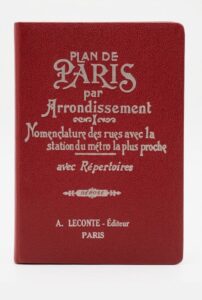
    By this point I’d been to Paris with Eugene a handful of times between early ’97 and mid ’99. So the city wasn’t such an unknown quantity to me anymore. In fact, from day one, I’d felt like I knew my way around automatically, as if I’d been born with a Plan de Paris preinstalled in my mind’s GPS. That was particularly handy because at the time my highly advanced communication device was a Pager Swatch with a teeny tiny number display – mobile phones could just about display letters. It would be another 10 years before I could download Nokia maps on my phone.

    Going it alone was also strangely comfortable for me. Writing this now I’m starting to appreciate how very independent I have always been. It makes me think of the times when I was 16 and used to hitchhike back down to Cornwall from Guildford… Anyway, on with this story…

    Marion was on Eugene’s team. I had written her number in my blue address book along with any other Parisians I’d meet backstage, which was not many. Marion was the only one who pulled through. Oh, it would be so good to look at that address book! I’m sure it’s in a box somewhere. So yeh, I was already beginning to create myself a network and Paris was waiting to welcome me ‘home’, oddly Paris has always felt like home since those days. I’ve been back more-or-less every couple of years since.

    French turned out simply to be English minus German delivered in voice of René Artois from ‘Allo ‘Allo. My A-level got me further than I expected.


    When the cash ran low, random opportunities followed. Waiting tables in an all night American bar. Testing computer games for a French computer games studio for the American market. Mainly though, assisting Marion on her Longchamp shoots, and a week or so in a very chic salon on Avenue George V. Soon I found myself blow-drying Christophe Robin’s clients in his newly opened colour only studio, walking his little dog around the Tuileries. It was either a chihuahua or a dachshund, I can’t remember which — but boy oh boy did I feel like I blended in!

    When the cash ran low, random opportunities followed. Waiting tables in an all night American bar. Testing computer games for a French computer games studio for the American market. Mainly though, assisting Marion on her Longchamp shoots, and a week or so in a very chic salon on Avenue George V.

    Soon I found myself blow-drying Christophe Robin’s clients in his newly opened colour-only studio, walking his little dog around the Tuileries whenever nature called.

    It was either a chihuahua or a dachshund, I can’t remember which but boy oh boy did I feel like I blended in!

    In retrospect, I firmly believe we create our own luck, or more precisely we create the circumstances for luck to find us.

  • Farewell at Hôtel Costes

    Call sheets came by fax. We photocopied them, marked them up, and passed them around backstage. This was pre-email, pre-smartphone. Practically speaking, it was pre-internet. The world ran at the speed of paper, of physical objects moving between hands, of decisions made face to face because there wasn’t another way.

    Eugene and I had been working together for about eighteen months by then. The London-based team took multiple trips a year to Paris. It was a working rhythm I’d grown into and enjoyed.

    One afternoon I went to his room at Hotel Costes to tell him that I had decided to move to Paris.

    I hadn’t planned the conversation. I just knew I needed to say it before I caught the evening Eurostar back to London. I knocked on his door. He let me in and I told him the news.

    His response was immediate and calm. He pointed out that his is a London-based team. If I moved to Paris, that would mean I could no longer be on his team. He said it without weight, without accusation. Just a fact.

    I think my exact words were something like:

    “Yeah, but… Paris!”

    That was my whole argument. That was everything I had to say for myself. Paris. As if the word alone explained the decision, the pull, the inevitability of it. Maybe it did.

    He didn’t try to stop me. No argument, no persuasion, no friction. He respected me and my decision completely. He said to call back in before catching my evening Eurostar.

    I understand his response more now than I did then. At nineteen, I just took it as Eugene being Eugene. Easy, unflustered, ungrudging. It’s only with distance that I see the full shape of what he did. He was losing a team member. He’d invested time in me, brought me to Paris repeatedly, he’d given me a place inside something that obviously matters deeply to him: his team. And when I told him I was walking away from it all, his response was to respect the choice and let me go cleanly.

    There was no manipulation. No “are you sure?” No quiet reminder of what he’d done for me. No Devil Wears Prada attitude, just cool calm acceptance.

    I know now that this was a kindness most people are just not capable of. Most people, faced with someone leaving, find ways to make the leaver feel the weight of it. Guilt, pressure, the soft suggestion that they might be making a mistake. Eugene gave me none of that. He gave me permission, even though I hadn’t asked for it.

    When I came back that afternoon, he came down from his room with a copy of the first Hotel Costes CD in his hand. Mixed by Stéphane Pompougnac. He gave it to me as a parting gift and wished me well.

    I played that CD to my friends as soon as I got back to London, I transferred it to my MiniDisc player and listened to it for years afterwards. Listening back to it now, it has become one of those albums that’s so completely of its time it almost stops being music and becomes a portal into the past. Lounge, downtempo, the late nineties / early noughties in audio form. I still have it at home somewhere, in a box with all my old stuff at my parents’ place.


    Years passed, decades in fact. Then, recently, I came across a copy in my local Oxfam bookshop. Of course I bought it without hesitation.

    I put a note inside it. More than a note really, a message, and quite an intense one at that. The kind of thing you can only write when enough time has passed to allow you to say what needs to be said. I told him about what that exchange meant, about what his response taught me, about the shape of his kindness, which I only fully understood years later.

    The CD and note sat in my kit bag at the salon for at least a month, waiting.

    When Eugene finally came in to the salon to prep for a big shoot recently, I gave it to him.

    I couldn’t see his expression properly as he opened it. I was in the middle of a haircut, but I’m sure I caught the corner of a smile as I turned back to my client.

    He kind of just stuffed the note into one of his unpredictable pockets.

  • Paris with Eugene

    I remember standing in the minimal dark bathroom on that first evening in Paris before dinner. A film set of a bathroom. Looking at my reflection I thought about my school friends; many of them confided that their degrees felt pointless and that they were just going through the motions because they didn’t know what else to do. They were waiting tables or stacking supermarket shelves to pay their way towards degrees which they really weren’t sure about.

    I was staying in a hotel on Rue St Honoré ready for Paris Fashion Week.

    I did have the unnerving sense that I’d ended up somewhere I wasn’t supposed to be: impostor syndrome. But ultimately it was Eugene who’d asked me to be there and who was I to question his judgement? I knew my way around a hairdryer just as well as I knew how to plug a MiniDisc player into a backstage sound system. I was useful, I was there and I deeply wanted to help. Although I hadn’t planned it, it was great. Having fallen into hair like this, all I had to do now was just figure out a way of staying around and keeping it together.

    Eugene gave me his MiniDisc and Creative Soundblaster, a subwoofer with four tweeters, to plug together and place strategically around backstage. This was long before Bluetooth. Setting up the sound system was always one of the very first things we did. Once the tunes were playing, everything else started to slot into place. Eugene introduced me to KRS-One through that glorious setup, and I never let that thread drop.

    Individual pret-a-porter shows are hard to separate now, they’ve merged into one. The pace of them, the noise, the cigarettes, the champagne afterwards. Studio visits are calmer and clearer memories. Sarah Moon was cogitating elegantly through a very bright rooflit loft studio. Paolo Roversi was smoking heavily, drinking lots of coffee, he had a patio with trellises and dark ground floor rooms.

    The slower Haute Couture mornings I also remember more clearly. One that particularly stands out decades later was Viktor and Rolf in what might as well have been a full-on greenhouse of a studio. Everywhere there was an intense seriousness and dedication about the work. A quiet focused methodical work, timelessly prepared for.

    Eugene moved through all of it with a quality I didn’t have a word for then. I do now: Sprezzatura from the Italian meaning something like studied effortlessness. Nothing performed, nothing wasted; just an easiness with existence. I find this calmness about Eugene so comforting; it’s like he emanates peace. Even in places like Paris, which I think he once told me is his least favourite city.

    I was watching everything. Taking in as much as I could.

  • My name on a board in Gare du Nord

    Eugene’s first mission for me was as follows: Get on the Eurostar to Paris. Go to Delorme. Buy plain black barrettes. Bring them back to London.

    He conveyed this mission with a particular humility that’s unique to Eugene.

    He knew what it sounded like, sending someone to Paris to go shopping for hairclips. He’d tried hard to find the particular design the brief called for – completely black and flat, nothing ornate or unusual; deceptively simple. But they were nowhere to be found in London. So, to Paris it was!

    I got off the Eurostar at Gare du Nord having smoked myself silly all the way there in the dedicated carriage. When I stepped out of the arrivals gate, lo and behold there was the chauffeur holding a board with my name written on it! Obviously I had been told that was the plan, but actually seeing this man dressed in a black suit and tie walking me to a a brand new Mercedes, driving me through Paris to Le passage de l’Industrie. Nothing like that had ever happened to me before.

    I hadn’t been to Paris since I was very young. I had no memory of those visits, apart from a vague recollection of going up the Eiffel Tower. Standing there at Gare du Nord, my name on a board in front of me, it felt like a spiritual homecoming.

    I stepped out of the car and in through the glass doors of Delorme. There were very many plain black barrettes, I found the specified shape and style, bought them all and made my way back to London.

    It turned out the clips on the inside also needed to be black, but the shape was perfect. We spray painted the clips. To this day I’ve never seen a black barrette with a black metal clip.

    Believe me, I’ve been looking!